
Most scalpers do not lose money because their strategy is wrong, but because small, repeated mistakes compound faster than small wins — with small targets, every leak takes a large share of each win. The competitor guides all list the same mistakes, but none prices them, none gives a journal metric, and none offers a worked example or fix plan. This guide does all four, for seven mistakes.
The most common scalping mistakes are targets too small for costs, overtrading, moving the stop, revenge trading after a loss, trading dead hours with wide spreads, trading through red-folder news unplanned, and trading without a journal. Each one has a measurable cost in pips, a journal metric that exposes it, and a fix you can test in 30 days.
The assumptions behind every number in this guide
Every cost below is sourced from a guide we read or computed from labelled assumptions. Pair: EURUSD. Total cost per trade: 1.2 pips (spread plus slippage) — apptrading.ai's figure: a 3-pip target with 1.2 pips of cost loses 40% to costs. Baseline plan: 6-pip stop, 9-pip target, a 1.5R plan; one R is the planned risk, equal to the 6-pip stop. Size: 0.10 lot, about $1 per pip, so 1.2 pips is $1.20 and 1R is $6.00. Risk per trade: 0.25–0.50% on M1, per apptrading.ai. No win rate or profit figure here is presented as fact — the only numbers are costs, which a scalper can measure exactly.
Mistake 1: targets too small for costs
What it is. Taking trades with targets so small that spread and slippage eat most of the win.
What it costs. Apptrading.ai states the math: a 3-pip target with 1.2 pips of cost loses 40% to costs (1.2 ÷ 3). A 3-pip winner nets 1.8 pips; a 3-pip loser costs 4.2 pips, because the cost is paid on the loss too. With a 6-pip target, the same cost is only 20%, and the winner nets 4.8 pips.
The journal metric. Cost share: total cost divided by gross target over 20 trades. Above 25%, your targets are too small. Log the spread at entry.
The fix. Set targets at least 5× your total cost, per KCM Trade's academy — with 1.2 pips of cost, the minimum target is 6 pips. Skip any setup that cannot clear that bar; test it for 20 trades and keep it if cost share falls below 25%.
Mistake 2: overtrading
What it is. Taking trades outside your plan because the chart is moving, you are bored, or the last trade "almost worked". KCM Trade: most scalping problems come from too many unplanned trades, not the strategy.
What it costs. Under the labelled assumptions, every extra trade costs 1.2 pips whether it wins or loses. Ten extra low-quality trades in a week cost 10 × 1.2 = 12 pips — $12 at 0.10 lot, $60 at 0.50 lot.
The journal metric. Trades per session against your cap, and the share taken without a named setup. KCM Trade recommends 10 trades or 3 losses per session, then stop. If more than 20% of your trades have no setup name, you are overtrading.
The fix. Cap the session at 10 trades and 3 losses, and trade one session window per day — London open or the London–New York overlap. When the cap is hit, close the platform.
Mistake 3: moving the stop
What it is. Widening the stop loss after entry because the loss "feels" wrong. KCM Trade: the stop is part of the plan, and widening it breaks the position-size calculation.
What it costs. Under the labelled assumptions, the planned stop is 6 pips, or 1R. Widen it to 12 pips and the loss doubles to 2R — an extra 1R, or 6 pips, on a trade that was already a loser. Do it weekly and you add 6 pips of cost for no upside.
The journal metric. Realised loss divided by planned loss, in R. Log the planned stop and the actual exit. Above 1.0R on average, you are moving stops — a clean scalper sits at 1.0R plus slippage.
The fix. The stop is set before entry and never widened. If you cannot accept the stop, your size is too large — reduce size, do not move the stop. On a $5,000 account risking 0.5% ($25), with a 5-pip stop at $10 per pip for 1.0 lot, size is $25 ÷ (5 × $10) = 0.5 lots. Do that division before every session.
Mistake 4: revenge trading — sizing up after a loss
What it is. Doubling size, or taking an immediate re-entry, to "make back" a loss — the fastest way to turn a normal losing day into an account-damaging one.
What it costs. Under the labelled assumptions, a normal loss is 1R, and a double-size revenge loss costs 2R. One loss followed by one double-size revenge loss is a 3R session drawdown instead of 2R — an extra 1R, or 6 pips, paid for a trade taken angry rather than planned. Two in a row turn a 1R loss into a 5R hole.
The journal metric. Size after a loss divided by planned size. Log lot size on every trade and mark the trade after a loss. Above 1.0× on average, you are revenge trading.
The fix. After 2 consecutive losses, step away for 15 minutes — apptrading.ai's "two strikes" rule. After 3, stop for the session, per KCM Trade's cap. Never increase size after a loss.
Mistake 5: trading dead hours and wide spreads
What it is. Scalping outside the liquid windows — late Asia, pre-London, post-New York — when candles are small and spreads are wide.
What it costs. Assume the spread widens from 1.2 pips in liquid hours to 3.0 pips in dead hours. On a 6-pip target, the cost share jumps from 20% to 50%. Each dead-hours trade pays an extra 1.8 pips; five in a week cost an extra 9 pips, and winners net 3 pips instead of 4.8.
The journal metric. Average spread at entry, split by hour. Log spread and hour on every trade. If your average spread outside the London open and the London–New York overlap is over 2× your average inside them, you are paying a dead-hours tax.
The fix. Trade one session window per day and skip everything outside it. Before entry, check the spread: no trade above 20% of your target — apptrading.ai's rule, which for a 6-pip target means no trade above 1.2 pips.
Mistake 6: trading through red-folder news unplanned
What it is. Holding or opening scalps into a high-impact release — CPI, NFP, a rate decision, FOMC minutes — without a plan for it.
What it costs. Assume a news spike slips your stop by an extra 3 pips beyond the planned 6-pip stop, turning a 1R loss into a 1.5R loss — an extra 0.5R, or 3 pips, per event — while the spread at the release runs several times normal. One a week costs roughly 3 pips of slippage plus a doubled spread — 12 pips a month no entry skill recovers.
The journal metric. Slippage per trade — requested versus filled price — and trades within 10 minutes of a red-folder release. If average slippage on news-window trades is over 3× your average elsewhere, the news is where your edge leaks.
The fix. Check the calendar before the session and mark the high-impact releases; take no new positions 10 minutes before and after each one. To trade a release, do it deliberately — post-release retest plan, half size, spread cap — not by accident. See our US retail sales scalping guide for the worked version.
Mistake 7: no journal — flying blind
What it is. Trading without logging entries, stops, targets, spreads, and results. Every other mistake here is detectable only through a journal; without one, you fix the wrong one — usually by adding an indicator.
What it costs. The cost of no journal is the other six mistakes going unmeasured. Overtrading alone costs 12 pips a week — 48 pips over four weeks that a journal would have exposed in week one. KCM Trade says judge rules only after 50+ journaled trades; without a journal, you never reach 50 measured trades.
The journal metric. Journal completeness — trades logged divided by trades taken — must be 100%. Log pair, time, setup, entry, stop, target, spread, slippage, result in R, and one review sentence. Below 100%, every other metric here is unreliable.
The fix. Log every trade before taking the next one — no exceptions. Review the journal every Friday for 10 minutes: cost share, trades per session, realised loss in R, size after losses, spread by hour, news-window slippage, completeness. One review a week, six numbers.
Summary: what each mistake costs
| Mistake | Cost per occurrence | Detection metric | Fix |
|---|---|---|---|
| 1. Targets too small | 40% of a 3-pip target (sourced) | Cost share above 25% | Target at least 5× total cost |
| 2. Overtrading | 1.2 pips per extra trade | Over 10/session or 20% unplanned | Cap 10 trades / 3 losses |
| 3. Moving the stop | Extra 1R (6 pips) per widened stop | Average realised loss above 1.0R | Stop set pre-entry, never widened |
| 4. Revenge trading | Extra 1R per double-size loss | Size after a loss above 1.0× planned | Pause 15 min after 2 losses; stop after 3 |
| 5. Dead hours / wide spreads | Extra 1.8 pips per trade (assumed) | Spread outside liquid hours over 2× normal | One window; spread cap 20% |
| 6. News unplanned | Extra 0.5R slippage per event (assumed) | Slippage on news trades over 3× normal | No trades ±10 min of red-folder news |
| 7. No journal | All six unmeasured (48 pips/month) | Journal completeness below 100% | Log every trade; review six metrics weekly |
Worked example: the cost of a 20-trade week
Example — not live prices. Assume a scalper plans 10 trades in a week on EURUSD, then adds 10 low-quality trades by overtrading. Each trade costs 1.2 pips, and all 20 break even before costs — low-quality, not losers, which is the generous case.
The 10 extra trades cost 10 × 1.2 = 12 pips — 12 × $1 = $12 of pure cost at 0.10 lot. If the planned 10 had averaged +2 pips net each, the week would be +20 pips; with the extra 10, it is +8 pips. Overtrading did not just cost 12 pips — it cut the week's result by more than half.
Now add mistake 3: one moved stop widens a 6-pip loss to 12 pips — an extra 6 pips, or $6 at 0.10 lot — and the week falls from +8 pips to +2 pips. Two small mistakes, both invisible without a journal, erase a winning week.
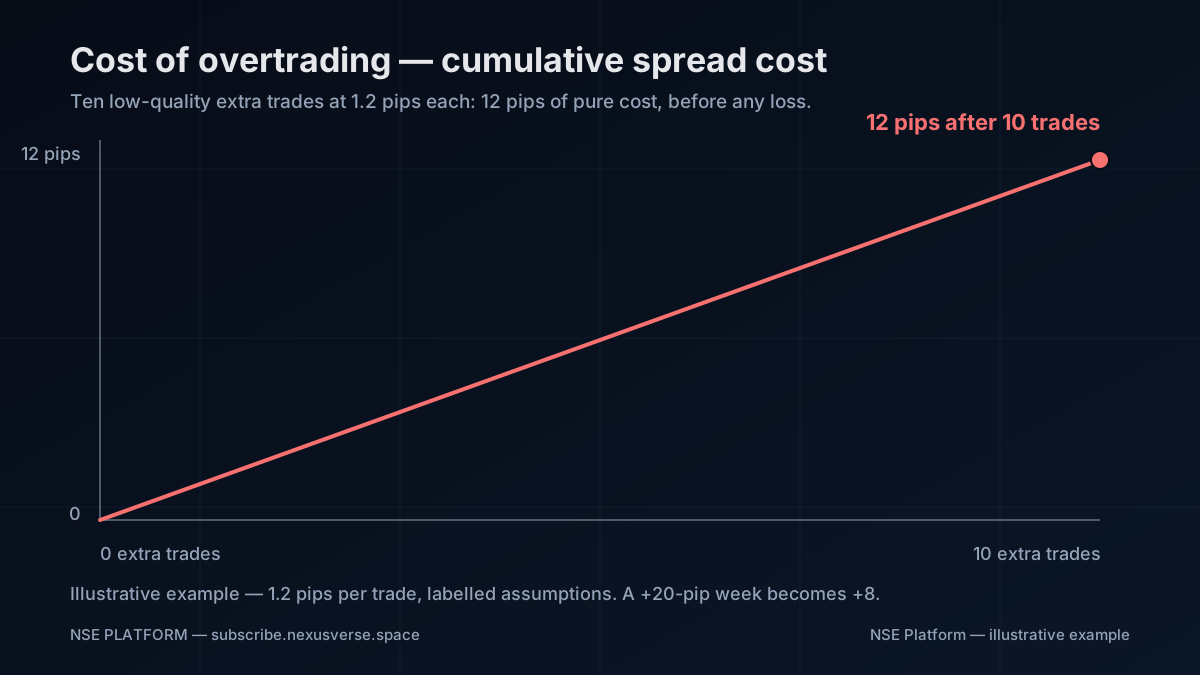
Chart: the cumulative spread cost of the extra trades, rising 1.2 pips per trade to 12 pips across 10 trades — an illustrative example with labelled assumptions, not live data.
The 30-day fix plan
Fix them in order, one per week, and measure each one before moving on.
Week 1 — Measure only. Change nothing except the journal: log every trade with all columns — pair, time, setup, entry, stop, target, spread, slippage, result in R, one sentence of review. Check: completeness is 100%, and you can state your cost share, trades per session, and realised loss in R.
Week 2 — Fix the cost filter. Apply the 5× rule and the 20% spread rule: no trade unless the target is at least 5× the total cost and the spread is below 20% of it. Trade one session window only. Check: cost share below 25%, zero trades outside your window.
Week 3 — Fix the caps. Enforce the 10-trade and 3-loss caps, the 15-minute pause after 2 losses, and the never-widen-the-stop rule. Check: zero stop moves, zero trades after the caps, post-loss size at 1.0× planned.
Week 4 — Review and keep what works. You should now have 50+ journaled trades — KCM Trade's minimum before judging a rule. Rank the mistakes by pips lost. Check: the most expensive mistake from week 1 costs at least 50% less, and completeness is still 100%. If a rule did not move its metric, drop it.
For the foundations — strategy, session windows, position-size formula — read our scalping strategy guide, forex scalping for beginners, and ATR position sizing.
FAQ
Why do most scalpers lose money?
Because costs and discipline leak faster than small wins accumulate. With targets of a few pips, a 1.2-pip cost is a large share of every win, and each mistake in this guide adds pips per occurrence. The strategy is rarely the problem; the leaks around it are.
How many trades per day should a scalper take?
Cap the session at 10 trades, as KCM Trade recommends, and stop after 3 consecutive losses. Apptrading.ai suggests 4–8 a day for beginners, in a single session window. If over 20% of your trades have no named setup, your cap is too high.
What spread is too wide for scalping?
No trade if the spread is above 20% of your target — apptrading.ai's rule. For a 6-pip target, that means no trade above 1.2 pips. KCM Trade's version is targets at least 5× the total cost. Either way, the spread decides whether the setup exists.
How do I stop revenge trading?
Make the pause mechanical: after 2 consecutive losses, step away for 15 minutes; after 3, stop for the session. Never increase size after a loss. If your journal shows size after losses above 1.0× planned size, the pause rule is the fix.
Sources consulted
- apptrading.ai — Forex Scalping for Beginners (2026) — apptrading.ai
- KCM Trade Academy — Scalping in Forex (2026) — academy.kcmtrade.com
- TraderDetector — Scalping Forex Strategy for Beginners — traderdetector.com
Educational material only — not financial advice. Forex and gold trading with leverage can produce substantial losses. Backtest and demo-trade any setup before risking real capital.