
The minutes of the Federal Open Market Committee's 27–28 October meeting were released on 18 November 2026 at 19:03 UTC. The vote had been 10–2 to hold rates, with only Lisa Cook and Beth Hammack dissenting. The minutes showed a committee far less settled than that vote suggested — including participants open to a hike of more than 25 basis points. For FOMC minutes scalping, the gap between the vote and the text is the whole trade.
FOMC minutes scalping is trading the volatility that follows the FOMC minutes release, at 19:00 GMT. The minutes can reprice rate expectations within minutes, widening spreads and whipsawing USD pairs and gold. Scalpers wait out the first spike, then trade the retest with half size and a stop beyond the spike extreme.
What happened: the minutes behind the 10–2 vote
The headline lines, per InvestingLive, 18 November 2026, 19:03 UTC:
- "A couple of participants noted that an increase of more than 25 basis points could warrant consideration at the next meeting if incoming inflation data were unfavorable."
- "A few participants who supported no change in rates suggested it was a close call."
- "Some participants favoured a 25 bp hike at the meeting." Only two members, Cook and Hammack, dissented — a 10–2 vote.
- "Almost all participants judged that further hikes would likely be appropriate."
In Fed language, "some" means more than "a few": Cook and Hammack had company among the non-voters, so the 10–2 vote understated how hawkish the meeting was.
CoinTelegraph, at 00:35 UTC on 19 November, agreed: "Fed officials saw October rate hold as a 'close call,' minutes show". This is the same hawkish reset covered in our earlier piece; that article covered the reset, this one covers the minutes and the scalp plan.
Why it moved markets
A 10–2 hold told the market the Fed was done debating; the minutes said the opposite. A hike of more than 25 basis points in December went from unthinkable to priced. InvestingLive's 21:33 UTC wrap called it "Waller/Fed minutes put a bigger December hike in play".
As reported that evening: the Dow fell 561 points; the Treasury auctioned $16B of 20-year bonds at 5.459%; the dollar traded near a 19-month high; spot gold fell below $3,800 for the first time since September 2025; the S&P 500 closed below its 200-day average.
CME FedWatch pricing read on the morning of 19 November put a December hike at 95.7% for 25bp and 4.3% for 50bp — small, but near zero before these minutes. InvestingLive also notes Waller set a 0.3% core CPI threshold for 50bp, which the October CPI met — and these minutes predate that report.
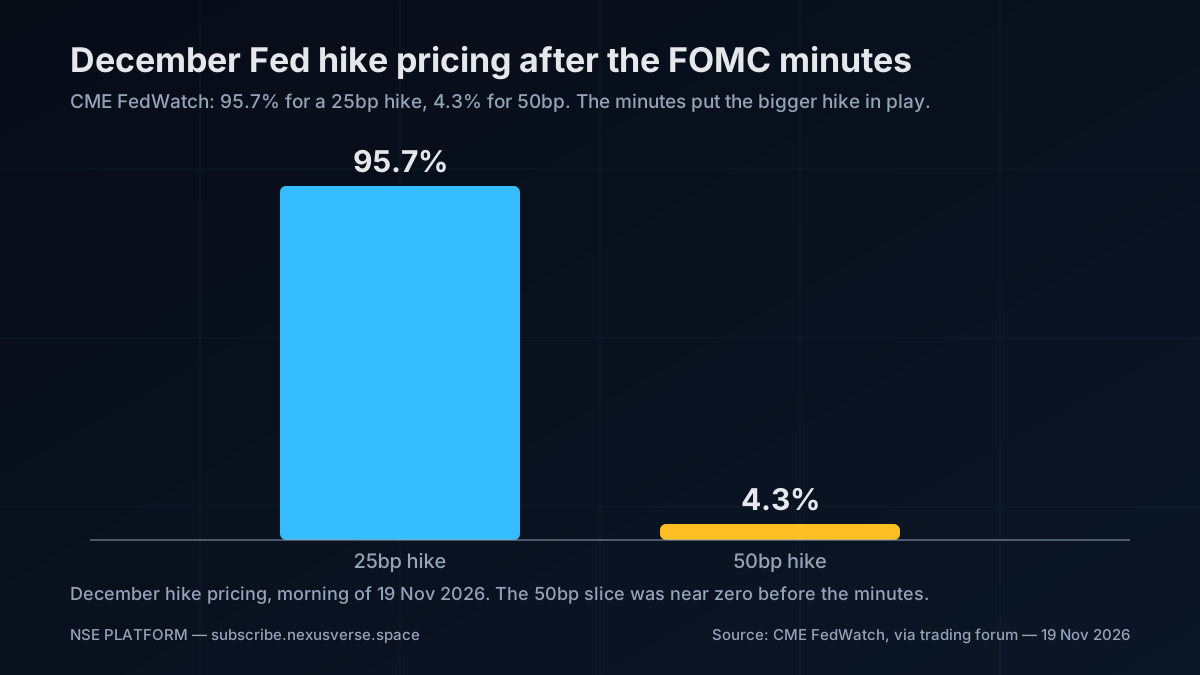
Chart: CME FedWatch December pricing after the minutes — 95.7% for 25bp vs 4.3% for 50bp, read via a trading forum post on the morning of 19 November 2026.
What it means for scalpers
Minutes releases are among the worst of the month for spread and fills. In the first 1–2 minutes after 19:00 GMT, spreads widen, algos whipsaw price both ways, and stops near the market get swept. Trading FOMC minutes forex in that window is not scalping — it is paying the spread to be the liquidity.
- No new trades from 5 minutes before to 15 minutes after the release — the first spike is noise; the tradable move comes after it.
- Flatten or cut size before the release — do not carry a full-size scalp into 19:00 GMT.
- Expect the spike to reverse at least once — the first move is often the wrong one.
- Re-engage only after the spike settles: wait for a 1-minute close, mark the extreme, trade the retest.
Gold needs extra care: spot gold is below $3,800 for the first time since September 2025, and its spread widens more than EURUSD's. Our gold below $3,800 playbook covers the gold rules — smaller size, respect for the spread.
The post-minutes scalping plan
Trade this only if the conditions below are met; if they are not, there is no trade — and saying so is part of the plan.
- Wait out the blackout: no new trades from 18:55 to 19:15 GMT. Watch the release; do not trade it.
- Let the first 1-minute candle close. Never enter on the spike candle.
- Mark the spike extreme: the high and low of the first 2–3 minutes on M1 and M5.
- Trade the retest, not the spike: enter only when price returns to the extreme and rejects it with a wick and a close back in the direction of the move.
- Spread cap: skip if the spread is more than 2× normal — EURUSD at 2 pips against a normal 0.8 is a stand-down.
- Half size on the first post-release trade — the market is still discovering the price.
- Stop beyond the spike extreme, plus spread — a stop inside the range gets swept.
- Target 1–1.5R or the next M5 level. Stop the session after 3 consecutive losses or a 2% daily loss.
Invalidation is the spike extreme, not an invented price level: a long is invalid on a close below the spike low, a short on a close above the spike high. If price chops inside the range for 15 minutes with no clean retest, the setup is dead.
For EURUSD: if no retest forms within 30 minutes, there is no clean setup — trade the London or New York range instead, or nothing.
The AUDUSD divergence trade
The same morning gave scalpers a cleaner story — a divergence trade. Australian unemployment jumped to 4.9% in October against 4.7% expected, and employment fell 43,500 against a forecast gain of 25,000. InvestingLive reported at 00:42 UTC on 19 November that the result is "taking RBA hikes off the table": AUD broke below 0.6700 as February hike pricing was removed.
The divergence is the trade: the Fed debates how much to hike while the RBA is, on this data, done hiking. Do not chase the drop below 0.6700 — it has already happened. Wait for a pullback to the pre-data level and a rejection, then trade with the divergence at half size under the same spread cap. If the pullback reclaims that level and holds, the trade is invalid.
Watch, don't trade: BOJ Governor Ueda said at 01:16 UTC on 19 November he expects to keep raising rates, warning inflation could overshoot 2%. That is a December hike watch for the yen, not a USDJPY setup — one comment does not create a plan.
What to watch next
- December 8–9 FOMC meeting. The question is now 25bp versus 50bp, and the next CPI decides. Trade the meeting as the minutes: blackout, then retest.
- Next CPI — the most important input before December; do not hold a directional scalp into it.
- BOJ December hike watch: Ueda's comments put a December move on the table; watch USDJPY around BOJ communications, do not pre-position.
- RBA February pricing. February was the next realistic RBA hike window; the jobs data has taken it off the table. If Australian data keeps weakening, talk turns to cuts — extending the divergence.
No single-direction prediction is offered: the minutes made a December hike near-certain and a 50bp move possible, and the data before 8–9 December decides the size.
FAQ
Can you scalp FOMC minutes?
Yes, but not the release itself. The tradable part is the 15–30 minutes after, once spreads normalise and the spike extreme is marked — trade the retest at half size, with a spread cap and a stop beyond the extreme.
What time are FOMC minutes released?
At 19:00 GMT (14:00 ET), three weeks after the meeting — the 27–28 October minutes came out on 18 November 2026 at 19:03 UTC. Plan the blackout around 19:00 GMT.
Is gold or EURUSD better for trading FOMC minutes?
EURUSD, because its spread normalises faster. Gold moves further — spot gold fell below $3,800 after these minutes — but its spread widens more, so size down.
Should beginners trade the minutes?
Watch the first release without trading it: spread widening, whipsaw, and speed punish every beginner mistake at once. Paper-trade the retest plan on demo for two or three releases, then go live at half size. See our retail sales guide and week ahead for the same rules.
Sources consulted
- InvestingLive — FOMC minutes, 18 Nov 2026 — investinglive.com
- CoinTelegraph — "close call" minutes report, 19 Nov 2026 — cointelegraph.com
- InvestingLive — Australian jobs, 19 Nov 2026 — investinglive.com
Educational material only — not financial advice. Forex and gold trading with leverage can produce substantial losses. Backtest and demo-trade any setup before risking real capital.